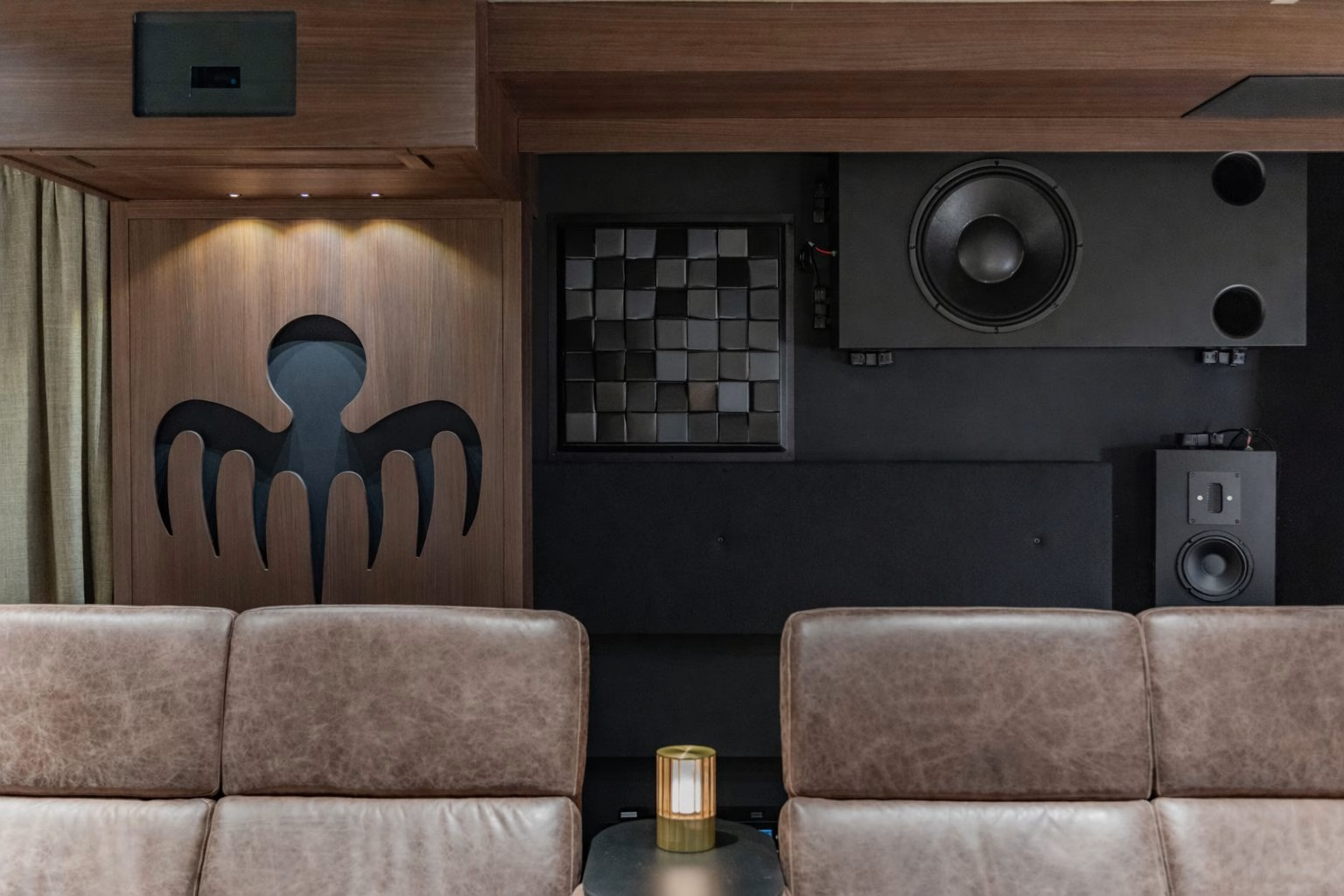
Acoustics Series: Part Two
Part One of this series established that the room is the most important component in a home cinema. Before a projector is selected, before a speaker system is designed, before a single cable is run, the acoustic character of the room has already begun shaping the outcome. Every decision made in the design of the space either supports or limits what the finished cinema can achieve.
Of all the acoustic challenges that a home cinema room presents, one is more demanding, more consequential and more frequently underestimated than any other.
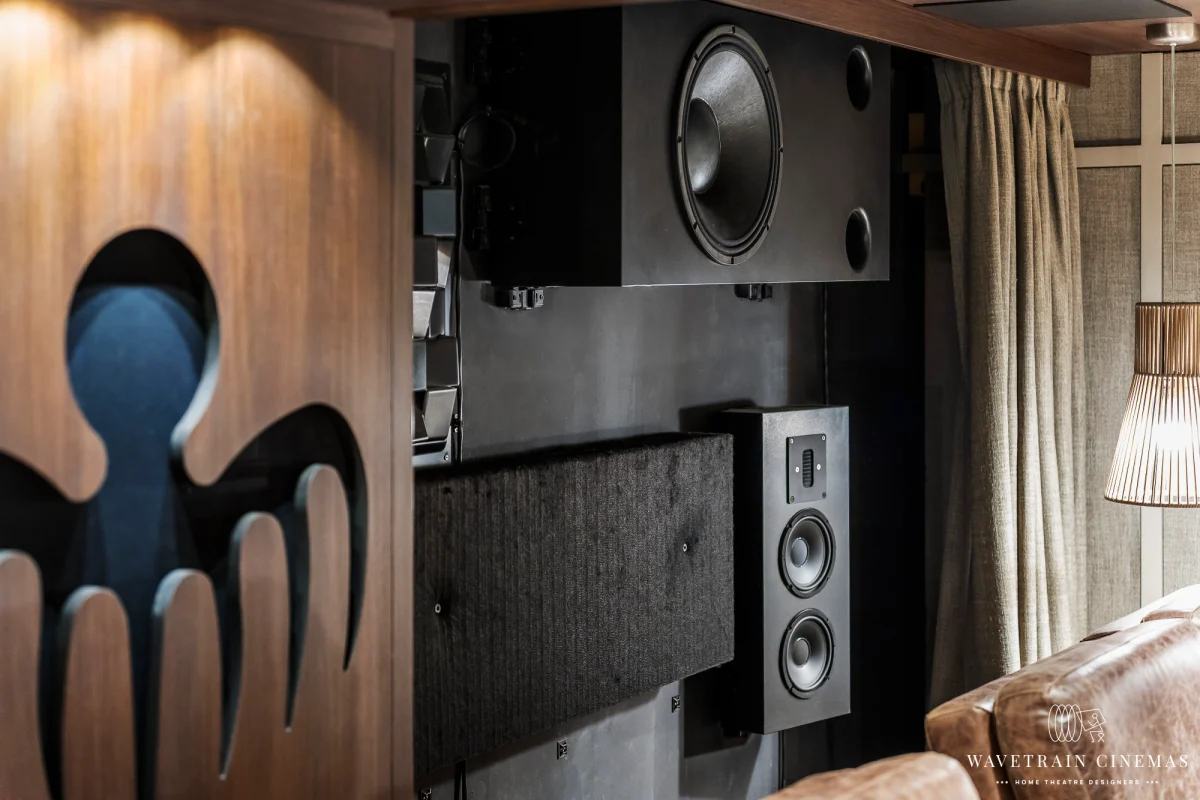
Bass
Low frequency performance is where the gap between a good-looking cinema and a genuinely high-performing one becomes most apparent. It is also where the most common and costly mistakes in home cinema acoustic design are made. Understanding why bass is so difficult to control, and what it actually takes to get it right, is essential for anyone commissioning a private cinema at a serious level of performance.
Why bass is different from everything else
In a home cinema, the full audio spectrum spans from the deepest rumble of a subwoofer at around 20Hz to the highest frequencies a tweeter can reproduce at 20,000Hz and above. Across that range, sound behaves very differently depending on wavelength.
High frequencies have short wavelengths. A 10,000Hz signal has a wavelength of approximately 34 millimetres. These sounds are directional, they travel in a relatively straight line from source to listener, and they interact with surfaces in predictable ways. A well-positioned acoustic panel on a wall or ceiling can intercept and absorb high frequency reflections before they reach the listening position. The treatment is visible, manageable and relatively cost-effective.
Low frequencies are governed by entirely different physics. A 40Hz bass tone, the kind of deep, physical weight that defines the impact of an explosion or the presence of a film score, has a wavelength of approximately 8.5 metres. A 20Hz signal, at the very bottom of the audible spectrum and the frequency range that gives a serious home cinema its visceral, chest-felt impact, has a wavelength of roughly 17 metres.
Those wavelengths are larger than most cinema rooms. The physics of how such large waves interact with a confined space are fundamentally different from the behaviour of high frequencies, and the acoustic treatment strategies that work for mid and high frequencies offer little meaningful help at the low end.
This is the central challenge of bass management in a private cinema. It cannot be resolved by applying panels to walls. It has to be addressed through the design of the room itself.
Room modes and the problem of standing waves
When a low frequency sound wave is generated in an enclosed space, it travels outward from the source, reaches a boundary such as a wall, floor or ceiling, and reflects back. In a room with parallel surfaces, that reflected wave travels back across the space and reflects again. If the distance between the two parallel surfaces corresponds to the wavelength of the frequency being produced, or a multiple of it, the wave reinforces itself. Energy builds at that frequency. The result is a room mode.
Room modes are not rare edge cases in poorly designed rooms. They are a fundamental acoustic consequence of placing a sound source inside an enclosed space. Every room has them. The question is not whether modes exist, but whether they have been anticipated, managed and integrated into the acoustic design of the cinema.
In practice, room modes create what acousticians call standing waves: patterns of high pressure and low pressure that remain relatively fixed in space at specific frequencies. At a pressure peak, a particular bass frequency will seem dramatically louder than it should. At a pressure null, the same frequency may be almost inaudible. These peaks and nulls are not subtle variations. In an untreated room with problematic mode behaviour, the difference in bass level between a pressure peak and a null can exceed 20 decibels at the same frequency. That is an enormous variation.
The practical consequence is a home cinema where bass performance changes significantly depending on where you are sitting. Two seats in the same row can sound like different rooms. The bass that feels tight and controlled in one position feels bloated and slow in another, and may seem to disappear in a third. In a cinema designed to seat multiple people, inconsistent bass performance across the listening area is one of the most common sources of dissatisfaction, and one of the least understood.

The axial, tangential and oblique problem
Room modes are categorised by the number of room dimensions involved in their formation.
- Axial modes involve two parallel surfaces: left wall to right wall, floor to ceiling, front wall to rear wall. They are the strongest and most audible modes because they involve the most direct reflection path and lose the least energy per reflection cycle.
- Tangential modes involve four surfaces and are somewhat less energetic.
- Oblique modes involve all six surfaces of the room and are weaker again.
Together, however, these three categories of mode combine to create a complex pattern of resonance throughout the bass range, with peaks and nulls distributed across the room in ways that are difficult to predict without acoustic modelling and measurement.
The frequencies at which axial modes occur are directly determined by room dimensions. For a room that is five metres wide, the first axial mode across that dimension occurs at approximately 34Hz. The second at 68Hz. The third at 102Hz. And so on through the bass range. The same calculation applies to the length and height of the room, generating its own series of modal frequencies.
When room dimensions are poorly chosen, multiple modes fall at similar frequencies and their energy compounds. This is known as modal clustering, and it produces a bass response that is particularly difficult to control. Certain frequencies become severely exaggerated while others, sitting in gaps between clusters, are relatively thin. The result is a bass response that feels uneven, coloured and unconvincing, regardless of the quality of the subwoofers or the precision of the calibration applied.
This is why room dimensions are not an arbitrary architectural decision in a private cinema. The proportions of the space have a direct and measurable relationship to the modal distribution across the bass range. Choosing dimensions that spread modes more evenly, and avoiding the ratios that cause problematic clustering, is one of the first acoustic decisions that has to be made in the design of a dedicated cinema room.
Why equalisation alone cannot solve the problem
A common assumption in home cinema design is that modern calibration systems can compensate for room acoustic problems. Systems like Dirac Live, Audyssey and the advanced processing built into high-end processors such as those from Trinnov and StormAudio are genuinely powerful tools. Their ability to measure and correct frequency response, manage timing alignment between speakers and address many room-related anomalies is impressive. But they operate within limits that are set by the physics of the room, and those limits are particularly hard when it comes to bass.
Equalisation works by adjusting the level of specific frequencies. If a room mode is causing a particular bass frequency to be 10 decibels louder than it should be at the listening position, EQ can reduce the output of the subwoofer at that frequency, bringing the measured level closer to the target. This is useful, and it is one of the tools that any serious cinema calibration will employ.
The problem is that EQ is applied to the signal going into the speaker. It affects what the speaker produces, but it does not change the acoustic behaviour of the room. If a mode is causing a bass frequency to peak at the primary listening position, that mode is also creating a null somewhere else in the room. Reducing the output at that frequency to correct the peak will make the null even worse. The room has not been corrected. Only one measurement position has been partially addressed.
For a cinema with a single listening seat, this trade-off may be manageable within limits. For a cinema designed to accommodate multiple listeners across several rows of seating, it is a fundamental constraint. EQ cannot create even bass performance across the room. Only acoustic design and thoughtful subwoofer strategy can do that.
This is not a criticism of calibration systems, which remain essential tools in any high-performance home cinema. It is an acknowledgement that calibration works best when the room it is working within has been acoustically designed to give those tools the best possible starting point.
Bass traps: what they can and cannot do
If acoustic panels cannot address low frequency problems, what can? The most common acoustic treatment approach for bass control is the bass trap: a structure designed with sufficient mass and depth to absorb low frequency energy rather than simply reflecting it.
Bass traps work on a different principle from mid and high frequency absorbers. Effective low frequency absorption requires treatment that is physically deep, typically a substantial fraction of the wavelength of the frequencies being targeted. A broadband bass trap capable of meaningful absorption at 60Hz needs to be significantly deeper than a panel designed for high frequency control. Corner placement is typically most effective because corners are where bass energy concentrates most strongly in a room.
Well-designed and well-positioned bass traps can meaningfully reduce the severity of room modes, smooth the bass frequency response and improve the consistency of low frequency performance across the listening area. They are an important part of the acoustic design of a serious home cinema room.
However, bass traps are not a complete solution in themselves, and they are not a substitute for considered room design. They work best when the room dimensions have been chosen to avoid the worst modal clustering problems, when subwoofer placement has been designed to excite modes as evenly as possible, and when the traps themselves are specified and positioned based on acoustic measurement rather than installed by rule of thumb. Bass traps applied without acoustic analysis can address some problems while leaving others unresolved, and in some cases can alter the tonal balance of the room in ways that are difficult to correct.
Subwoofer placement and the distributed approach
The position of a subwoofer in a home cinema room has a significant effect on which room modes are excited and how strongly. A subwoofer placed in a corner of the room will energise virtually all of the room’s modes simultaneously, because corners are the points of maximum pressure for every axial mode in the space. The result is typically strong but highly uneven bass, with pronounced peaks and nulls distributed throughout the room.
Moving the subwoofer away from the corner changes which modes are excited and how strongly. Placing it at the midpoint of a wall reduces its interaction with the modes generated by that wall dimension. No single position is perfect, but the relationship between subwoofer placement and modal excitation is predictable and can be modelled.
For high-performance home cinemas, the most effective approach to bass management is often a distributed subwoofer array: multiple subwoofers placed at carefully calculated positions around the room, each contributing to the overall bass output in a way that helps to even out the modal pattern rather than reinforce it. When multiple subwoofers excite the room’s modes from different positions, their combined effect can produce a significantly more consistent bass response across the listening area than any single subwoofer can achieve, regardless of how powerful or capable that single unit might be.
The number, specification and positioning of subwoofers in a private cinema is not simply an equipment question. It is an acoustic design question, and the answer depends on the specific modal behaviour of the room being designed.
What this means for a cinema commissioned at a serious level
Low frequency performance is the clearest differentiator between a home cinema that looks the part and one that genuinely performs. It is also the area where the gap between an acoustically designed cinema and an acoustically unconsidered one is most physically felt. Bass that is tight, controlled and consistent across the listening area creates a fundamentally different experience from bass that blooms, smears or varies from seat to seat. The difference is not subtle.
Achieving that level of low frequency control requires acoustic thinking that begins before the room is built. It requires:
- deliberate decisions about room dimensions and proportions;
- a subwoofer strategy that is designed around the specific acoustic behaviour of the space;
- bass treatment that is specified on the basis of measurement rather than convention;
- and calibration that is applied to a room that has already been acoustically prepared to give it the best possible starting point.
When Wavetrain Cinemas designs a private cinema, low frequency performance is one of the earliest and most detailed areas of the acoustic brief. We model modal behaviour from the proposed room dimensions before construction begins. We design subwoofer placement and array configuration for the specific geometry of the space. We specify bass treatment based on the acoustic character of the room, not a generic formula. And we calibrate the finished system with the understanding that measurement and correction work best in a room that has been designed to perform.
A home cinema should move you. Not just emotionally, but physically. Bass that is genuinely controlled, consistent and convincingly reproduced is one of the things that separates a cinema that achieves that from one that almost does.
For a private cinema or dedicated home theatre where low frequency performance is part of the design brief from the beginning, speak with Wavetrain Cinemas before the room is built.
Part Three of this series examines the difference between acoustic treatment and acoustic design: why panels on walls are not the same as a room that has been acoustically resolved, and what a genuinely designed acoustic environment actually involves.