In most industries, awards are occasional milestones. In luxury home cinema design, they mean something more. They are a signal. One that separates isolated success from sustained, world-class performance.
And when the same home cinema design company is recognised at the highest level, repeatedly, across different projects, categories, and regions, it raises an important question:
What are they doing differently?
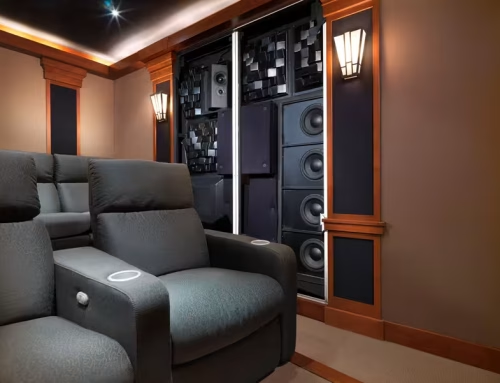
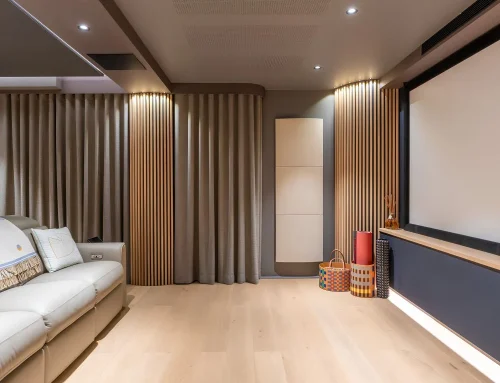
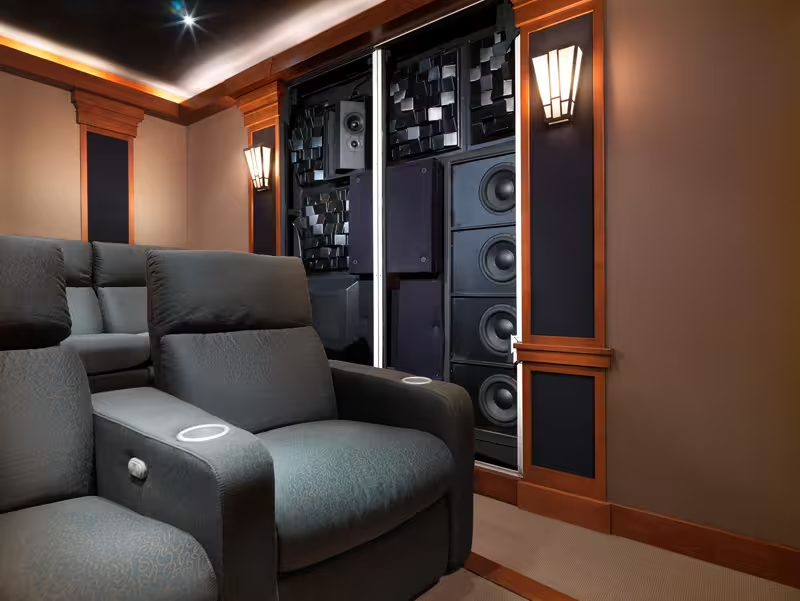
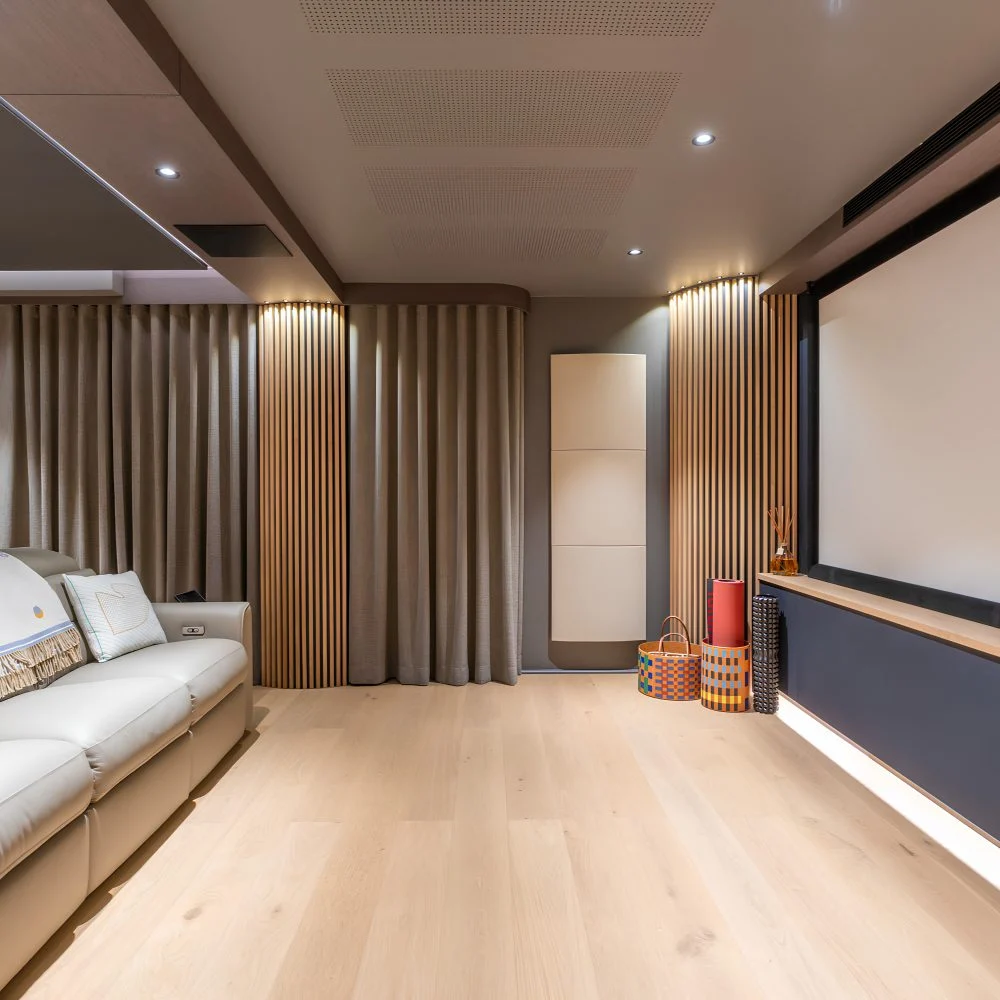
Wavetrain Cinemas is currently the only home cinema design company to have won CEDIA’s global home cinema title twice. The first came in 2023 for The Cloister Cinema. The second followed in 2025 when 007 Bahama Hideaway received Best Home Cinema Global at the CEDIA Smart Home Awards, alongside recognition as Best Home Cinema Level III within the Asia Pacific region.

Those awards matter because they represent far more than visually impressive rooms or premium equipment selections. They recognise complete cinema environments where acoustics, room geometry, light control, engineering, calibration and installation have been designed to work together as one integrated system.
In luxury home cinema design, a single award-winning project can happen under ideal conditions. Repeated global recognition across different projects, years and client briefs suggests something far more difficult to achieve: a repeatable process capable of consistently delivering reference-grade performance.
That consistency is one of the reasons Wavetrain Cinemas has become one of the most recognised luxury home cinema design companies in the Asia Pacific region, with multiple CEDIA awards across different cinema categories and performance levels.
Global Recognition Is the Outcome — Not the Starting Point
CEDIA’s global cinema awards are judged against leading home cinema projects from the Americas, EMEA and Asia Pacific regions. Winning at that level requires more than premium products or dramatic aesthetics.
It requires the room itself to perform at an exceptional standard.
The significance of 007 Bahama Hideaway is that the project demonstrates a design methodology capable of producing repeatable high-performance outcomes.
Built in regional Queensland, 007 Bahama Hideaway was designed to achieve two goals simultaneously:
- reference-level movie playback
- concert-scale dynamics and immersion
while minimising disturbance to the surrounding home environment.
Achieving that balance required careful coordination between architectural planning, acoustic engineering, projection performance, isolation strategy and final calibration.
That level of integration is where many luxury home cinemas begin to separate into two very different categories:
- rooms built around products
- rooms engineered as complete cinematic environments
Why Many Luxury Home Cinemas Still Underperform
One of the most common mistakes in high-end home theatre design is treating equipment as the starting point instead of the room itself.
Clients may invest heavily in premium speakers, processors and projection systems, yet still experience:
- inconsistent bass between seats
- unclear dialogue
- distracting reflections
- poor viewing geometry
- elevated noise transfer into adjacent rooms
- image contrast that feels flat despite high-end projection
In many cases, these problems are not caused by the equipment.
They are caused by design decisions made much earlier in the process.
For example:
- A brighter projector cannot compensate for uncontrolled reflected light within the room.
- Premium speakers cannot overcome poor room geometry or unmanaged low-frequency behaviour.
- A larger screen can reduce immersion if seating distances and sightlines are incorrect.
- Beautiful finishes can compromise acoustics if material selections are made without considering sound behaviour.
This is why reference-grade home cinema design is fundamentally different from assembling premium AV products.
The room itself becomes part of the system.
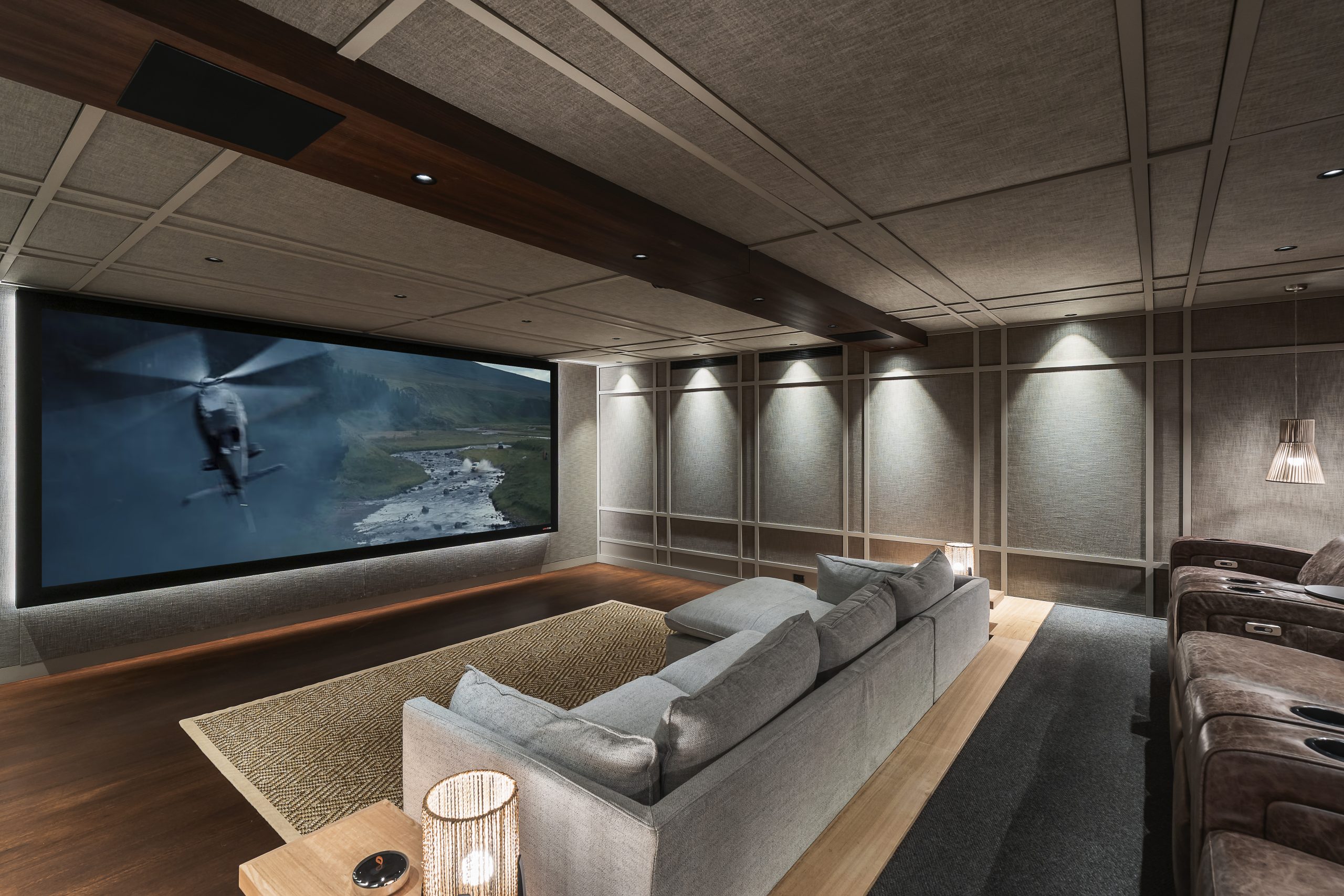
What Wavetrain Cinemas Does Differently
Wavetrain Cinemas approaches luxury home cinema design as a connected engineering and architectural discipline rather than a product-led installation.
The process begins long before final equipment selections are made.
Acoustic Engineering
Acoustic performance is considered during the earliest stages of room planning.
This includes:
- low-frequency room interaction
- reflection management
- speaker placement geometry
- seating response consistency
- sound isolation to surrounding areas
The goal is not simply powerful sound, but controlled and repeatable performance across every seating position.
A well-designed cinema should maintain dialogue intelligibility, tonal balance and dynamic impact without requiring excessive listening levels.
Room Geometry & Sightlines
Room dimensions directly influence how both sound and image behave.
Even small geometric decisions affect:
- seat-to-screen immersion
- surround envelopment
- bass consistency
- viewing comfort
- projector performance
In many underperforming cinemas, these relationships are compromised because room layouts are resolved after major architectural decisions have already been locked in.
Reference-grade cinemas require these variables to be addressed together from the beginning.
Light Control & Image Performance
True cinematic contrast is not determined by projector specifications alone.
Room surfaces, ceiling reflections and ambient light behaviour all influence perceived black level and image depth.
Even high-end projection systems lose visible contrast when stray reflections raise the room’s ambient light floor.
This is why luxury cinema environments require carefully controlled finishes, lighting integration and precision calibration to preserve image accuracy and dynamic range.
Calibration & Commissioning
A premium cinema system only reaches its potential after commissioning and calibration.
This stage involves refining:
- speaker timing and phase alignment
- room EQ optimisation
- HDR tone mapping
- colour accuracy
- brightness uniformity
- system integration behaviour
Without this process, even exceptional equipment may never perform as intended within the room.
The Difference Between “Luxury” and Reference-Grade
Many luxury cinemas are designed to impress before the film begins.
Reference-grade cinemas are designed to disappear once it starts.
That difference becomes noticeable in subtle but important ways:
- bass remains balanced across multiple seats instead of becoming overwhelming in certain positions
- dialogue stays clear without excessive volume
- dark scenes retain depth and shadow detail instead of appearing washed out
- viewers experience less fatigue during long sessions
- sound transitions feel seamless and believable within the space
These outcomes are not created by any single product.
They emerge from the relationship between acoustics, geometry, isolation, calibration and integration.
That relationship is ultimately what award judging evaluates.
Why Repeatable Performance Matters
A single successful project can happen under ideal conditions.
Consistent high-level performance across multiple projects usually indicates something more important: process discipline.
Wavetrain Cinemas’ global recognition for both The Cloister Cinema (2023) and 007 Bahama Hideaway (2025) demonstrates that high-performance cinema outcomes are not dependent on a single design style or isolated project condition.
What Clients Should Look for in a Luxury Home Cinema Designer
For clients planning a high-end home theatre, the most important questions are often not about brands or equipment.
They are about process.
A serious home cinema design company should be able to explain:
- how acoustics will be addressed before construction begins
- how room geometry will affect seating and speaker placement
- how light control will preserve projection performance
- how calibration will be handled after installation
- how performance will be measured and verified
The strongest indicator of quality is not a long equipment list.
It is a clear methodology for making the entire room perform as one environment.
This is also why awards matter when evaluating a cinema designer. Recognition across multiple projects and years can provide evidence that a company’s process is capable of delivering consistent results under different design conditions.
007 Bahama Hideaway as a Proof Point
007 Bahama Hideaway matters because it demonstrates what happens when every layer of cinema design is treated as interconnected.
Its recognition through not only the CEDIA Smart Home Awards but also and the 2026 Sound & Image Installation Gold Award validates the finished result, and the real significance lies in the process behind it:
- architectural integration
- acoustic engineering
- controlled projection performance
- isolation strategy
- calibration precision
- installation discipline
Together, those elements created a cinema capable of competing at a global level.
And importantly, it reinforced a pattern already established by The Cloister Cinema two years earlier demonstrating that exceptional performance is not tied to a single room, aesthetic or project type, but to a disciplined and repeatable approach to cinema design.
The Future of Luxury Home Cinema Design
As home cinema technology continues to evolve, the gap between product quality and system performance will only become more apparent.
The industry no longer lacks excellent projectors, speakers or processors.
What increasingly separates exceptional cinemas from merely expensive ones is the ability to integrate those technologies into a room that fully supports them.
That is where design, engineering and process become the defining advantage.
Frequently Asked Questions
What makes a home cinema “reference-grade”?
A reference-grade home cinema is designed to deliver consistent and accurate sound and image performance across all seating positions. This usually involves controlled acoustics, precise room geometry, calibrated projection performance, effective light control and professional system commissioning.
Why is room design more important than equipment alone?
Equipment can only perform within the limits of the room. Poor acoustics, uncontrolled reflections, incorrect seating positions and inadequate light management can significantly reduce the performance of even premium cinema systems.
What causes luxury home cinemas to underperform?
Common causes include equipment-first planning, poor room proportions, insufficient acoustic treatment, weak isolation, unmanaged reflections, incorrect viewing distances and lack of calibration after installation.
Why do award-winning cinemas require a different design process?
Award-winning cinemas are usually designed as complete performance environments rather than collections of products. Acoustics, geometry, lighting, projection and installation are planned together to achieve measurable and repeatable results.
What should clients ask before building a luxury home cinema?
Clients should ask how acoustics, room geometry, light control, calibration and construction methodology will be addressed before final equipment selection. The process behind the room is often more important than the individual products themselves.
Experience the Cinemas Behind the Awards
From The Cloister Cinema to 007 Bahama Hideaway, Wavetrain Cinemas’ award-winning projects demonstrate how acoustics, architecture and cinema engineering can be combined into a single performance-driven environment.